• Skip to primary navigation
  • Skip to main content
  • Skip to primary sidebar
  • Skip to secondary sidebar

How To Write A Campsite Business Plan

A Resource Site For Writing A Campsite Business Plan

  • About
  • Tips
  • Resources
  • Discussion
  • Contact
  • Privacy Policy

Editorial Staff

Plan A Profitable Departure: Exiting Your Campsite Business

September 23, 2025 by Editorial Staff

13 of 18

A major missing part of many business profit calculations is the exit value.

This translates into a business premium charged by the vendor to recompense them for their efforts during tenure of maintaining and growing a profitable business.

A lump sum payment.

For career entrepreneurs, the exit is the big pay-off. The real payday.

The interim earnings whilst operating the business were piecemeal reward or enjoyment for running the business.

But the real financial enabler and in many cases transformer is the exit value.

It literally can serve to reinvent a person’s entire personal financial reach.

And still with all this potential value – most small business owners completely undervalue exit.

To some, it’s not even a consideration.

A major missed opportunity.

…exactly how much of a missed opportunity?

That would depend on two things:

  • overall profitability of your operation, and;
  • appropriate chosen valuation multiplier

Take the case of a software company making £6,540 net profit, for example:

With a valuation multiplier applied of 70x monthly net profit…

…the owner of the business stands to make over:

£400,000 upon the sale of their asset, at current market rates.

With a choice between a £400,000 pay-off or a headache upon exiting the business – I know which one I would choose.

But what are the key success factors for achieving a profitable outcome upon exit?

Here are some known factors that help achieve market value for your business asset:

Books

Verifiable business financial records will prove profit figures and therefore support a valuation figure.

But that would depend on having ‘business books that are in good order, transparent and provide an evidence-based track record of trade’.

This kind of business tends to hold it’s valuable quite well. As the input figures cannot be debated.

Profit maximising

In preparation for sale it is common practice for businesses that are targeting an optimised sale value to groom their business profits.

In other words tighten up expenses and max output for increased profits.

If sustained over 6 months or more, the increase in net profit is usually considered stable enough to be considered in the value calculation.

Systemization & automation

An attractive sweetener for buyers in the potential acquisition of a business is a detailed library of processes, procedures and instructions for operation.

Such resource is considered a major risk reducer.

Why?

A going concern up for consideration offers one main advantage to starting up from scratch…

…immediate sale revenue, profit and take home pay.

No delay.

Getting to grips with processes and procedures can mean inefficient operations whilst the new owner learns the ropes to get up to speed.

A head start, with well documented standard operating procedures, will openly show a prospective buyer all they need to take care of for maintaining business profits, as they are at time of reading.

General housekeeping standards for achieving identical results.

Go To Part 14: https://campsitebusinessplan.co.uk/knowledge-base/1-campsite-business-case-study

Broaden Your Pitch: Growing Your Campsite Business

September 23, 2025 by Editorial Staff

12 of 18

A business is either growing or failing.

Each day, the silent erosion of increasing competition, accumulating debt and rising cost of inflation are gradually taking the edge off your future business benefits.

So, growth is should be seen as more of a necessity than a luxury.

Growing your business is like upgrading from a medium to a large refillable drink.

A larger container to quench a heavier thirst.

In the context of your campsite business, your operational capacity is dictated by the number of pitches you have on offer at any time.

The more available pitches offered simultaneously, means the more possible revenue up for grabs.

For example:

20 equivalent pitches offers double the potential business revenue of a 10 pitch set up.

Expansion

Expanding your campsite pitch capacity is a quick method of growth.

If you’ve got the space, adequate proportion of available toilet amenities and the staff coverage to prepare all pitches prior to arrivals – it’s possible you could be ready for expansion.

Remaining at a level lower than your absolute potential capacity would be the equivalent of throwing money away.

Sure, if it’s a ‘serviced pitch’ – you’ll need to factor in an electrical hook-up, or waste water drainage  – there will be a capital cost involved.

But overall, the increased revenue may well considerably outweigh the upfront capital investment.

Expansion of an existing business operation is seen as a relatively low risk strategy, on the basis that you’ve already proven both the demand and your ability to satisfy supply.

It’s just a matter of:

More of the same. However, if expansion is either not possible or favourable, there is…

Diversification

Diversifying your business operations is a potential for every business.

The ideal win-win is to introduce a new line of business that:

  1. …plays to internal strengths, and;
  2. …provides sufficient enough demand to warrant the cost and effort of adopting a new business activity.

Misalignment with diversification is costly.

And is generally more likely to fail versus a well-thought out expansion project.

(Although, that is not always the case.)

Acquisition

Organic growth via expansion or diversification comes from within.

Internal resources mobilised to build a bigger or more diverse business.

But there is a quicker – inorganic route…

…to buy an existing business operation that does what you want to do – already.

An existing going concern has its attractions – mostly immediate cash flow from an existing customer base.

But it comes at the disadvantage of costing a lump sum business premium.

Plus, it can be a very intricate job of getting the new business to successfully transplant it into your existing portfolio of businesses.

This inorganic kind of business growth strategy is also filled with uncertainties and unforeseen problems from:

…hidden debt, inflated revenue to clash of company culture and incompatible software systems.

These in their own way can lead to a dampening down of the actual realised profits (and can even lead to losses) of your newly acquired business operation.

Acquisition is be approach with serious caution.

Benefit Cost Ratio

Either way, whether by expansion or diversification…

…what is the way of testing if your growth plan is a financially profitable one?

The answer for most financial professionals is the benefit cost ratio/analysis BCR or BCA.

What is BCR?

Benefit cost ration is exactly as it sounds. The relative amount of project cost vs. project benefit – expressed as a ratio.

Simple enough, however the one more technical side of the BCR is net present value (NPV).

Net present value

Go to Net Present Value Calculator

(Screenshot taken from “Business Plan Bonus“)

Further reading: https://www.investopedia.com/terms/n/npv.asp

Net present value is the adjustment of monies invested today to account for it’s future projected value tomorrow.

A major factor to include in such calculations is inflation.

The devaluing fact of life in this credit-based era.

The purchasing power of our money today, will be less tomorrow because of the rising cost of living lifted by the use of credit.

Why?

The cost of borrowing i.e. interest.

Usury is the practice of adding a rate of return to the lender at as a percentage of the principal sum lent on top of repayment.

A reward to the lender for affording the benefit to the borrower for using his money for a period.

If the essential to life houses we live in are mortgaged on usury, then suffice to say this will impact our general cost of living.

The inflationary effects of usury will be felt across the board. This is commonly known as the rise in the cost of living…

…expressed as retail and commercial prices going up constantly as the ripple effects of the cost of credit are absorbed and passed on by all involved.

Because of this, any future projection of income earned must (for prudence sake) include the cost of inflation too.

Within the context of a BCA benefit cost analysis – this cost (of monetary value erosion) is deducted away from future projected earnings to the percentage forecast.

i.e. a 4% expected inflation rate is deducted year on year from future earnings.

After this, a simple division calculation can be performed to determine how many times the project costs can be divided into the overall adjusted project benefit (profits).

The resulting ratio is known as the benefit cost ratio.

  • A ratio of over 1 would indicate that the project offers a financial reward for running it: Green light. Go.
  • A ratio of under 1 would indicate that the project does not offer a financial reward for running it: Amber or Red light. Slow down towards stopping or even a firm ‘Stop’.

Go to Benefit Cost Analysis Calculator

(Screenshot taken from “Business Plan Bonus“)

Further reading: https://www.investopedia.com/terms/c/cost-benefitanalysis.asp

Go To Part 13: https://campsitebusinessplan.co.uk/knowledge-base/exiting-your-campsite-business

Profit Control: Project Management For Campsite Start-Ups

September 23, 2025 by Editorial Staff

11 of 18

Starting up a business is a project.

An idea (backed by a scheme of work) put forward with the hope of achieving an end result.

Whilst project management isn’t is actually running the business.

Rather, it’s the foundation work that the future enterprise is built upon.

The business is the fruit of the project being completed successfully.

Project management therefore by nature and importance is discipline all in its own right.

Not at all to be likened with or confused with business management…

…project management is quite a different beast altogether. Although, closely related to running a business.

Project management has more to do with the control of predefined resources to bring about the expected product (which in the case of business start-up is a launched enterprise).

By strict definition, project management is:

“…the use of specific knowledge, skills, tools and techniques to deliver something of value to people.” (Project Management Institute)

Project management can be broken down into series of subjects, topics or components. All topics having their unique relevance.

However, in the case of planning and controlling the business profits of a future campsite enterprise, the following project management disciplines perhaps have the most transferable value:

Work

The first step in attaining control of your business profits is gaining clarity on the scope of work that contributes to your results.

Having a granular (‘grain-by-grain’) handle of every item of work grants ability to manipulate outcomes.

The overall achievement in business is the bigger picture.

But the individual threads of work which intertwine and present a composition are what matter most.

These are the elements that you must grasp to steer your efforst towards success.

And the work breakdown structure is the ideal instrument for visualising this:

Go to Work Breakdown Structure (WBS)

(Screenshot taken from “Business Plan Bonus“)

Further reading: https://www.workbreakdownstructure.com/

Cost

The number one fear or risk involved in planning a project is getting your figures wrong and having more cost on your hands than anticipated.

Similarly with business management, underestimating cost is a real risk on future profits.

Play down your outgoings in planning and you’ll thrust full speed ahead expecting open road, only to encounter an unexpected traffic jam which at best delays you.

But at worst could cause a head-on collision.

The cost of which could result in a complete abandonment of the mission.

In avoidance of this, project management tools like work breakdown structure and cost estimation do a great job of helping you establish a grain-by-grain handle of your cost.

For example, establishing a cost per booking that involves absorption of all preparatory activities, like clean up and maintenance helps you build in sustainable profit.

Go to Basis of Cost Estimate Calculator

(Screenshot taken from “Business Plan Bonus“)

Further reading: https://www.designingbuildings.co.uk/wiki/Base_cost_estimate

Scheduling

No. 3 on the list of things to avoid when managing projects is lateness.

Late deliverables cost money and disappoint expectations.

This in itself can be very costly.

To keep a tight grip on time management project managers traditionally use schedule planning tools like:

Gantt charts…

…to help them and the project contributors visualise the timing expectations of activities and their interdependence on one another.

Take the lead time to prepare a pitch before accepting new guests:

If this is underestimated, your business runs the risk of offending guests who arrive to meet substandard service levels.

This loses you repeat business and flushes away profit.

Go to Gantt Chart Template

(Screenshot taken from “Business Plan Bonus“)

Further reading: https://www.projectmanager.com/guides/gantt-chart

https://campsitebusinessplan.co.uk/knowledge-base/growing-your-campsite-business/: Go To Chapter 12

Money Management: Campsite Business Financial Planning

September 23, 2025 by Editorial Staff

10 of 18

Financial prudence will go a long way to you establishing a long-term successful campsite business.

And as far as business and financial planning is concerned, there are some standard instruments of use.

Here are a few which will help you keep sight of and maintain those campsite profits.

Cash Flow Forecast

Cash flow is defined as

“…the net balance of cash moving into and out of a business at a specific point in time.” (Harvard Business School Online).

The cash flow forecast is a statement of all cash inflows and outflows within a business taken as a snapshot at a specific time.

When running a business it is critical to keep a constant eye on net cash on hand  with a view on future flows.

This way you can:

  • forward plan dealing with business expenses
  • very quickly identify any issues resulting in negative cash flow
  • communicate confidently with suppliers and creditors

Operating with such monetary foresight helps you keep your business accounts in good standing with suppliers.

This means no hitches or spanners thrown into your operational performance.

Expediency to keep your business up and running.

(*n.b. It’s important to note that a business that enters in to negative cash flow i.e. having a greater cash demand than a cash supply at any given time, isn’t therefore unprofitable as a result. It just means that the monies required to have on hand vs. the monies actually received at any particular time were not aligned sufficiently. It might be that after all the trade has occurred for that reporting period, say month/quarter/year, that the business works out having made money rather than lose.)

Example cash flow calculator:

Go to Cash Flow Calculator

(Screenshot taken from “Business Plan Bonus“)

Further reading: https://www.investopedia.com/terms/c/cashflow.asp

Profit and loss

Profit loss or income statement is defined as:

“…the resulting balance that remains when all of a business’s operating expenses are subtracted from its revenues.” (Harvard Business School Online).

In short, a grand scale subtraction equation which takes away all monies due to go out vs. monies due to come in.

Simplified, it can be summarised as:

income – expenses = profit/loss

Profit isn’t all just one kind however.

In business, we have a variety of definitions of profit which describes monies left over or owing at different stages of financial treatment.

Here are a few example profit definitions common to every business:

  • Gross profit = direct cost of sale minus sale revenue
  • Operating profit = (direct cost of sale + indirect costs) minus sale revenue
  • Earnings before interest, tax (EBIT) = operating profit minus depreciation/amortisation

Each has its own analytical use in evaluating the overall performance of your campsite business.

How are they used?

These metrics to be used in combination with one another like the indicators on your car dashboard telling you in what state of health your car is really running.

‘Driving’ your business safely without them just isn’t possible.

Example profit/loss calculator:

Go to Income Statement Calculator

(Screenshot taken from “Business Plan Bonus“)

Further reading: https://www.investopedia.com/terms/i/incomestatement.asp

Balance sheet

Possessions both physical and intellectual can have a remarketable commercial value.

By definition, assets are described as:

“…resource with economic value that an individual, corporation, or country owns or controls with the expectation that it will provide a future benefit.” (Investopedia)

To realise their value, assets can be used to generate revenue or capital sums.

For example, a shepherd’s hut purchased for a sum of money can generate value or benefit for your campsite in two ways:

  1. Booking income from rent.
  2. Capital sum from a sale.

The same could be said of a patent held by you for a piece of software that is licensed out for use.

You might generate revenues from the licenses sold. But also from the capital sale of the patent to another owner.

In both ways, the patent or registered design can be used to realise a value for your business – although in principal it’s an intangible piece of information that can’t be touched.

On the contrary, a liability is defined as:

“…obligation of a company that results in the company’s future sacrifices of economic benefits to other entities or businesses.” (Investopedia)

One example, might be a burden on debt, for example, from a loan. This would be a legally binding contract that requires full repayment according to a given schedule.

In such case, the loan contract signed would be seen as a liability and recorded on your balance sheet.

The overall balance of asset value vs. liability describes the health of your business’s financial possession as far as:

…value owned vs. value owed.

An important backstory to your current trading position.

*A point on liquidity: the biggest fear of a business in this modern era of commerce is insolvency…

i.e. not having sufficient profitability to cover all of your creditor obligations, leaving you exposed to legal action against for recovery of monies owing.

One of the first moves of a business facing insolvency, much like a sinking ship, is to cast off all the lading and tackling.

In other words, relieving the ship of the additional burden of otherwise valuable cargo and equipment in a time of jeopardy.

In the case of a business, a stock inventory for example might be significant profitable value if sold.

But when facing impending insolvency (legal action from creditors to recover debts), the short term liquidation or converting of inventory assets in wholesale amounts immediately – for survival…

…is worth MUCH more than holding onto the stock for future sale.

Frankly, they’ll simply be no future sale is the shop is repossessed by the bank.

This is reality faced by every business suffering the threat of insolvency.

So, as a precautionary measure it’s worth always running a business that has a greater asset value than liability debt.

And to hold assets that can readily be sold and hold consistent market value.

This way you always give yourself the best chances of avoiding ship wreck if your liabilities are called in, by force.

Example – balance sheet template:

Go to Balance Sheet Calculator

(Screenshot taken from “Business Plan Bonus“)

Further reading: https://www.investopedia.com/terms/b/balancesheet.asp

Labour budget

Labour is one of the most misunderstood aspects of small business financial planning.

Many owner/managers run into trouble when trying to decide whether to count their own time and labour in their financial calculations.

For example, you might ask:

If I expect to spend approximately 30 hours a week running my campsite – do I charge for my time and pay myself a salary within my business plan, or not?

The answer to this always is:

No value is given without cost. For value gained somewhere, value has to be lost elsewhere. It’s a closed system. You can’t create business value, you can only transfer.

On that basis, you’d be short changing yourself not to include your personal time involvement at cost within your business expenses.

Otherwise, you’d be saying, I’m happy to run my business free of charge.

Which business manager out there would want to walk in your shoes?

They just don’t exist, right? We all need to eat, after all.

Unpaid labour is a fallacy.

And actually, can be a major trip up when trying to exit your business.

Just think – what if a prospective buyer of your business, doesn’t want to run it themselves?

They’d have to hire a manager, right?

Now consider how attractive (or otherwise) your profit/loss or income statement might look with the additional expense of a market rate operations manager added on top…

…this can and has often been a deal maker vs. deal breaker.

Example – payroll statement calculator:

Go to Payroll Calculator

(Screenshot taken from “Business Plan Bonus“)

Further reading: https://www.xero.com/uk/glossary/payroll/

Break-even

A business break-even point is defined as…

Break Even Point

The equivalent of the biting point in a manual transmission car.

The point at which the driving motions of the car become engaged by the torque or thrust of the engine output.

This is where the action happens and you and your passengers start to derive the benefit of being onboard.

Being carried by your business as a financial investment vehicle is very much the same.

The first thing done is fuel the car with all the necessary input to produce drive.

Bu then under the driver’s command the component’s of the car are brought into engagement to produce motion.

And I’m sure you’ll agree that a business just isn’t a business without carrying the owners and workers financial burden.

There just wouldn’t be any point otherwise.

Crossing the break-even barrier brings your business into profit and reward. The equivalent of coming out of neutral and entering into drive.

A critical moment and metric for every business. Perhaps the point-operationally where your business actually becomes a ‘business’.

Example – break even calculator:

Go to Break Even Calculator

(Screenshot taken from “Business Plan Bonus“)

Further reading: https://www.investopedia.com/terms/b/breakevenpoint.asp

Key performance indicators (KPIs)

Speaking of cars, where would you be without your trusty dashboard as a driver?

In business, your key performance indicators do the same job as a car dashboard for a driver.

They tell you how your car is doing at any point in your journey.

  • Petrol
  • Speed
  • Light display
  • Water levels
  • Oil reserve

All critical to maintain and have under your control behind the wheel, all readily readable at a glance of your dashboard.

The same should be the case for your campsite business key performance indicators, say…

  • gross profit
  • average booking value
  • direct cost of sale
  • sales conversion rate
  • bookings by volume this month

…they quietly tell you: “…speed up”, “…slow down”, “…full beam for limited visibility.” etc.

Go To Part 11: https://campsitebusinessplan.co.uk/knowledge-base/project-management-for-campsite-start-ups/

Retain Custom, Retain Profits: Campsite Repeat Custom

September 23, 2025 by Editorial Staff

9 of 18

A highly profitable area of campsite and accommodation business strategy is retaining repeat custom.

For every customer gained you lose money from your efforts in potential customers lost.

In other words, no business out there converts 100% of all their potential business.

Even the biggest brand names in the world have competition:

  • iPhone has Samsung
  • McDonald’s has BurgerKing
  • Nike had Adidas

etc…plus, there are hundreds of other brands too which make up the entire marketplace.

This means companies must accept that for every £1 or $1 spent attracting new customers, there will be some customers which prefer to go elsewhere.

With a well honed marketing engine, successful businesses can pretty much pin down their customer conversion rate (e.g. potential customers attracted divided by actual new customers gained multiplied by 100) down to a fine figure.

Taking businesses like your campsite, industry averages on conversion rate might be 5%.

i.e. for every 100 website visitors gained via Google search, your campsite business website would gain 5 new customer bookings.

And if the costs of attracting 100 potential new customers is say £300.00 and the sales revenue gained from 5 new customers was £500…

…then the gross profit is £200.00 from 5 customers, or £40.00 per new customer.

HOWEVER, if you do a great job of pleasing your clientele, they’ll book again. And keep booking.

So the job of attracting a new customer pays you back £40.00 after their 1st booking.

Then, say, £100.00 for every subsequent booking thereafter – without any further cost of ‘acquisition’ (cost of attracting them).

Another 10 bookings with you grossing £1,000.00 increasing your returns by 25,000%

Major profit.

But how do you keep you clientele coming back in a more predictable pattern?

There are some industry standard methods that are known to grind out the results without causing annoyance, if done well.

In a nutshell, it comes down to target automated marketing communications.

In other words, maintaining a relevant conversation with your audience members.

Now, certainly is not a one size fits all approach of spraying down your mailing list subscribers with spammy mailshots until they surrender.

But rather choosing well appointed moments of interaction to build on the commercial value to offer.

Nurturing the trust and appreciation via technology.

Here are 4 methods used successfully by market leading businesses to increase their repeat customer bookings:

Reviews

Asking a customer for a review following their recent visit is a great reason to stay in touch after their booking.

Not only does it demonstrate care of duty as a business owner both to them and other customers,

But it’s also a very persuasive piece of collateral that if gained will increase your new bookings too.

With the aid of a customer relationship management software, you can easily programme an automated review request email that does the job of asking for you.

Say, every 20 customers asked, you get a review.

You can quickly gain a catalogue of valuable customer reviews with very little effort spend.

CRM

A customer relationship software is a great investment for you campsite business.

It’s essentially a digital database that you put all you useful customer information into.

Each customer has a profile and helps you stay on top of managing communications with each audience member.

A CRM will help you communicate either en-masse and also 1-to-1 with customers.

Recorded information detailing your customers’ interaction with your business will provide relevant insights to guide you in more profitable future interactions.

Pitch booked, amenities used, make-up of guest party etc…

…are all details that will help you better align a relevant array of offerings, next time around for a more mutually valuable outcome.

Email Marketing

Piggybacking off your CRM should be a fully featured email marketing software.

Why?

  • 29% of marketers rate email marketing as the most effective marketing channel (25% for social media, 22% for SEO, and 25% for content marketing).
  • 93% of B2B marketers use email channel for distributing content.
  • 72% of customers prefer email as their main channel for business communication.

(Source: Snov.io)

It’s well-evidenced, the if you want to stimulate repeat bookings amongst your current audience – it’s best to use email.

It’s the most effective, welcomed and popular repeat business sales channel as used in industry.

Social Media

Last of all, but not least by any measure, is social media.

The world’s #1 ‘technologically-enabled’ method of sharing social and personal communication used by anyone (a sweeping statement, but probably not far off).

According to Forbes, 81% of consumers’ purchasing choices are influenced by their friends’ posts on social media.

(Source: Social Media Today)

Also…

21% of consumers are more likely to buy from brands that they can reach on social media.

(Source: Sprout Social)

Couple this with the average daily usage figures of social media:

(Source: Oberlo.com)

…and we can quickly begin to see the commercial potential provided by this communication channel.

Keeping conversation with an engaged audience via social media gives plenty of opportunity for your campsite to remain ‘top of the mind’ for many prospective and existing customers.

Ultimately, a great way of stimulating repeat bookings.

Go To Part 10: https://campsitebusinessplan.co.uk/knowledge-base/campsite-business-financial-planning

Planning Your Share: Campsite Market Research

September 23, 2025 by Editorial Staff

8 of 18

So now you’ve profiled the right size, type and value of campsite for sale to fulfil your earning expectations –

…next is to plan it’s presentation to paying guests.

Estimating Online Market Size

Much like with our earnings estimation exercise, we start with the big picture and work backwards.

In other words, we reverse engineer our final figure.

Before trying to work out a realistic share of the market, you start by estimating the entire market size.

And let’s face it, the internet is the no. 1 method for potential guests across the country doing their research.

But the question is: “How many people exactly are potentially looking for your campsite?”

Here’s a quick formula for how you get to that figure…

1. Understand how people search (use Google):

People use Google to perform research.

To obtain information which helps make decision.

Making an informed decision for a campsite booking could make:

(a) all the difference to the enjoyment of the experience, plus;

(b) could assist the customer in getting best value on the deal.

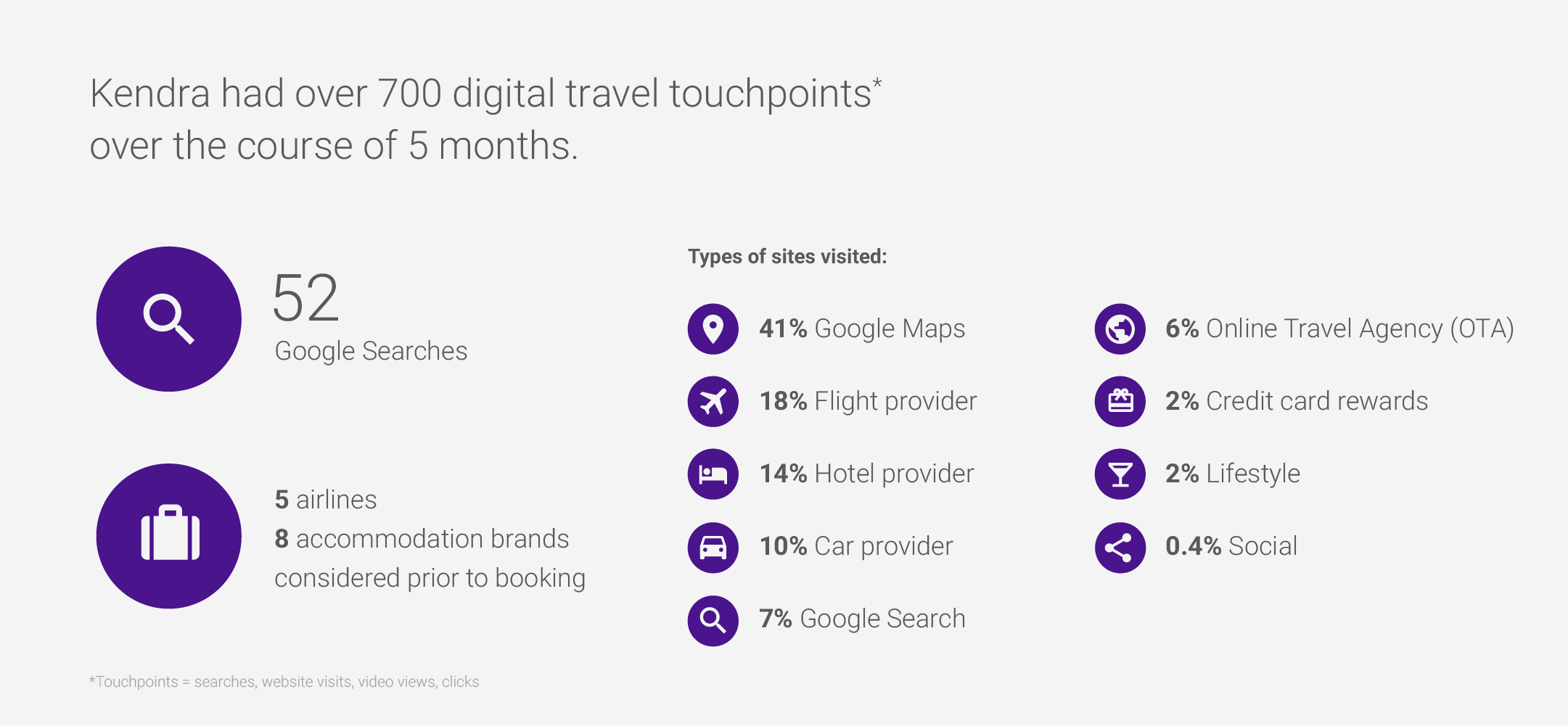
Research isn’t a one-off occasion either…here’s an example holiday booking customer journey illustrated by Google:

Kendra Travel Touchpoints

In the example above, the holiday guest ‘Kendra’ actioned over 700 ‘digital touchpoints’ (inc. searches, web visits, video views and clicks) within 5 months of online research before booking here holiday.

Amongst those 700 digital touchpoints were 52 Google searches.

Google Maps was the #1 most visited web app, followed by providers, Google Search and OTA (online travel agencies).

Also, a shortlist of up to 8 accommodation options were considered.

From this, you can take away the following ‘must-haves’ for marketing your campsite online:

  1. Invest in a decent brand and website
  2. Optimise your website for appearing prominently in Google Search
  3. Populate your campsite business website with content that sells your value proposition
  4. Make sure you can be easily found using Google Maps
  5. Register some availability with OTAs like https://campsites.co.uk
  6. Partner with other holiday providers in the area for referral web traffic
  7. Land some PR spots in relevant Lifestyle publications
  8. Maintain visible social media profiles

2. Choose your county, narrow down & get an estimate

The first criteria prospective guests will use when searching for a campsite is location.

If they are new to camping in your region, they might begin with a broad search like:

‘Campsite in Devon’

Such a search phrase in the online marketing industry is termed a ‘keyword’ – key or important as it were to your target audience searcher.

Using a software tool like ahref’s Free Keyword generator you can get an estimate for the number of people typing that phrase into Google on a monthly basis.

Being located, for example, in Brixham (Devon) your larger catchment area would be Devon.

Typing “campsite in devon” into the ahrefs Keyword Generator Tool, we get the following average monthly Google Search estimate:

Not only does the tool give us an estimate for the main keyword itself, but also related keywords such as:

“campsite in devon with swimming pool”

…which attracts some 70 searchers (or potential customers if that description applies to your campsite).

Beyond this, (in the example of your campsite in Brixham, Devon), you’ll no doubt want your campsite website also to show for search terms or keywords like:

Typing this into the tool, we can see a significant amount of monthly searches for:

“campsites in brixham”

In fact this search term attracts 250 monthly visitors (potential customers) per month, on average. This is half of the overall searches for the whole of Devon county.

3. Modify your search

Searchers with savvy are very specific with what they type into Google.

Their subject knowledge leads them to demand of Google a more precise set of results.

Not only this, but the more specific the search typed in typically suggests a potential searcher who is closer to making a buying or booking decision.

Let’s take the example of a husband and father looking to make a campsite booking for his family.

He and his wife know Devon is their chosen county, but as yet are not set on exactly where.

The take to Google to research, beginning with ‘campsites in Devon’.

They view the first few results on Google and examine what’s on offer.

Problem is, he find all sorts of campsites catering to all sorts of audiences.

So, he decides to narrow down…

He now types in:

“best campsites in devon for families”

He discovers a few more he didn’t know about, plus they are family-friendly

He wants to take his campervan and notices not all his shortlisted sites would accept that.

So he narrows down again, typing:

“campsites in devon for campervans”

Now, he gets results that complement search even more – giving him more viable booking options.

And finally, a plus point would be a swimming pool and in Brixham. So he types in:

“campsites in brixham with a swimming pool”

(This is an example digital journey experienced by a potential customer and the related Google search terms used to support their decision.)

Your job is to consider ALL the permutations searched for and to optimize your website for appearing prominently.

4. Use content marketing for lead generation

All the above now leaves you with the task of maximising the visibility of your campsite online.

This will lead to a sustainable market share.

So, having researched the search terms your target market are actively typing in every day – you can now target those Google results pages with CONTENT.

This is known as content marketing.

As defined by Content Marketing Institute:

“Content marketing is a strategic marketing approach focused on creating and distributing valuable, relevant, and consistent content to attract and retain a clearly defined audience — and, ultimately, to drive profitable customer action.”

In other words, feeding your target market’s hunger for research and assisting them to make a buying decision (ultimately profiting from the outcome yourself).

The modern day version of signposting what you do and benefiting from the commercial traffic.

And with content marketing, you should always use your website as the primary vehicle for content.

Why?

This gives you much more control and ownership over the content produced.

Ultimately, content is more profitable in your own website than in someone else’s.

Continuing with the example of your campsite in Brixham, Devon…

…your prospective customer, the husband and father used the following keywords in his Google research:

“best campsites in devon for families”

“campsites in devon for campervans”

“campsites in brixham with a swimming pool”

Assuming your campsite in Brixham ticked all those boxes – you’d definitely want to show up on the Google Search page for all those searches.

This maximises your incoming website visitors, potential books and earnings.

Next, you need to decide what type of content is required for best results.

The answer here lies in the purpose.

The purpose of all content marketing is to help the researcher make a buying decision.

This context, therefore, dictates the nature of the content.

Here’s how:

Our potential customer, the husband and father looking to book a holiday for his family is researching.

But with the intention of eventually making a booking.

His goal has a value (a happy holiday for his family), therefore he’s willing to spend the time and effort to do his research for the best outcome.

However, there is a limit to his patience. Life is busy and booking a holiday is not the most pressing priority.

In fact, a holiday is an expense – albeit a worthwhile one if you get it right.

His risks are:

  • missing better campsites than the one he booked
  • paying more than he should have
  • failing to maximise all the potential value that he could have i.e. amenities and activities
  • scrapping the preferred camping idea for another holiday type
  • not booking at all

So during his research via Google he has certain questions that he want direct answers to for building up his knowledge on what’s available.

This will lead him to make a confident decision.

And the sooner, the better. A holiday booking is a time-sensitive purchase. Every minute counts in the lead up.

Framed by the potential customer’s need for:

  • answers to questions
  • time efficiency

You would do best to produce content that:

  • gets straight to the point of competently answering potential customers’ questions
  • delivers the answers in the most appropriate, digestible and memorable way

Going back to your list of keywords, here are some example types of content that might hit the mark:

  1. best campsites in devon for families –
    • Content recommendation: an expanded list of campsites as personally recommended by other families, ranked by visitors. Verified reviews would help them decide which is truly ‘best’.
  2. campsites in devon for campervans –
    • Content recommendation: a simple shopping list style presentation with campsites that fit the bill. Perhaps with a photo gallery from campervan owners of their vans on your site, or a list of well-considered FAQs.
  3. campsites in brixham with a pool –
    • Content recommendation: another list of relevant sites, but this time headed up with an interview from previous guests talking about what they liked most about your swimming pool facilities and experience.

Additional ideas for expanding your reach…

Would potential campers willing to visit Paignton, Totnes or Dartmouth consider visiting your Brixham site instead?

Possibly. They’re neighbouring areas and Brixham has it’s own appeal.

Why not publish lists on your website promoting reputable sites in neighbouring towns, with a twist…

…asking the question: “If you’re considering Paignton, meet some families that say Brixham is better!”

Perhaps publish 3 Q&A style interviews taken with visiting families to your campsite sharing why they would recommend Brixham and specifically, staying at your campsite.

Here’s why recommendations are vital:

Shoppers that clicked a product recommendation are nearly 2x more likely to come back to the webshop – 37% of shoppers that clicked a recommendation during their first visit returned, compared to just 19% of shoppers that didn’t click a recommendation during their first visit (clerk.io).

Visitors who interact with reviews and customer questions and answers are 105% more likely to purchase while visiting. (Bazaarvoice).

Online Competitive Analysis

To generate a share of the market online – you’ve got to be visible.

This process requires patience.

Plus, a ready supply of best practice.

And none better place to observe best practice than observing the best in the business.

This is the art of online competitive analysis.

For example, let’s say you’re looking to start a campsite in Cromer, Norfolk.

Typing ‘campsite in Cromer’ into Google Search will reveal the most prominent choices on the 1st results page.

Amongst the top 3 campsite businesses featuring on Google page 1 Manor Farm Caravan and Camping Site.

It’s the only family-run site of the lot.

The other sites are clearly owned medium sized commercial entities.

Taking a look Manor Farm as a model example, there’s a lot to learn for incorporating into your own efforts.

Using Ubersuggest online marketing analytical tool, you can quickly get an estimate of the overall search performance of a website like Manor Farm:

Above, Ubersuggest delivers a monthly estimate of naturally derived Google search traffic to be comfortably over 3,000 visits to the Manor Farm website.

Note: this monthly traffic estimate has some caveats attached –  (1) this doesn’t guarantee all visits are from customers ready to book, (2) neither does it mean that this figure is generated EVERY month, (3) nor does this figure include visits from people who come to the website WITHOUT searching via Google i.e. regulars…

This number does provide a ballpark expected figure however for the type of search traffic the Manor Farm website attracts via Google Search alone.

Nice to know…

…but the next obvious question would be:

“What are people typing into Google to find Manor Farm over 3,000 times a month?!”

Here’s where Ubersuggest increases in value by providing the 1st clue to the mystery of Manor Farm search traffic:

The above table gives a small insight into the Manor Farm website pages the generate the highest number of visitors from Google Search.

The top 5 are:

  1. The home page
  2. Useful links page
  3. A blog article covering the Cromer Carnival 2022
  4. The general prices page
  5. A landing page promoting campsite prices in a local area called Mundesley

And now to pinpoint the keywords or search terms that relate to all that traffic:

Looking through the list the majority keywords used by searchers to find Manor Farm via Google are what we call ‘branded keywords’.

In other words, keywords that are centred around the name of the business.

Therefore, these searchers are already familiar with the campsite and are using Google as a shortcut to the relevant related information.

That said, not all the main keywords are like this.

Among the list above we also find 2 keywords (one of which grosses 4,400 searches per month) that are not Manor Farm related.

‘camping east runton’

‘camping cromer’

Also, referring to the table above which displayed the top pages by Google traffic one of the pages on there gives note to another popular keyword that Manor Farm must be visible for not included in the table above.

Going by the page URL destination…

‘manorfarmcampsite.co.uk/prices/mundesley/’

…the keyword that relates to the traffic attracted by this page would be something like:

‘prices for campsites in Mundesley’

Checking Google we see the following:

Manor Farm campsite is right there amongst the top results on the 1st page of search results.

So, what do we learn from this exercise using Ubersuggest analytical software?

Two main lessons:

(1) Developing a reputable business that becomes synonymous with camping amongst your target audience is your no.1 marketing ploy.

(2) Choosing some well thought-out local camping related phrases that might be popular among your target audience will help you obtain greater market share.

Now, that’s Google Search covered.

But are there any other website traffic sources that we should be aware of that reputable sites like Manor Farm benefit from?

Using Ahrefs backlink analytical software we are able to identify major web traffic referral sources to the Manor Farm website.

Below, revealed by Ahrefs backlink analytical software that are responsible for referring a steady flow of incoming visitors to the Manor Farm website (potential guests simply click through from the referring site & reach Manor Farm site):

#1 The Guardian Online – 965 web site visits referred every month

(*The referring page is an article entitled, “10 of the best UK campsites: reader’s travel tips”)


#2 The Standard Online 66 web site visits referred every month & The Little Beach Bell Company 412 web site visits referred every month

(*The Standard Online referring page is an article entitled, “Staycation: Complete guide to booking a campervan holiday in the UK this summer.” The other site is a tent hire website homepage which carries a link to the Manor Farm site.)


#3 Flashpacking Family 2245 web site visits referred every month

(*This referring page belongs to a blog called Flash Packing Family and takes the form of a post called, “55+ Stunning UK Coastal Campsites You Don’t Want To Miss”.)


#4 Experience Norfolk 72 web site visits referred every month

(*The referring page on the Experience Norfolk website is a business directory entry.)


Together, these 5 articles posted on other websites produce *3,348 website visits from potential new guests EVERY month (*average).

That’s 40,176 website visitors per year.

An equivalent number of web visits the business gets from Google.

Granted, the Google traffic will be more targeted (in other words by nature more likely to be people looking for a campsite in that locality) and therefore will convert more custom.

But of the 40K website visitors generated from these other sites, it’s likely that Manor Farm experience a fair amount of business – if not free nationwide PR & brand awareness.

A decent edge gained over the competition.

Campsite bookings

Your campsite is like an empty cup.

Fill it – and you’ll enjoy the results.

Leave it empty and it becomes a taunt on a hot day when your thirst arises.

Bookings generally will fall into 1 of 2 categories:

  1. New Bookings (from guests who have never stayed with you before)
  2. Repeat Bookings (from guests who have already stayed with you before)

New bookings present the potential for making new revenue streams and attracting repeat future custom.

Repeat bookings present maximum profitability, or recurring money from regulars who require no new effort to convert.

Both have their perks.

Making bookings

Bookings are made remotely, in advance.

Quite different to walk ins with a shop, let’s say.

The channels by which books are made will differ from site to site.

But for the purpose of your campsite business, the typical choices (but by no means exhaustive) are:

  • phone
  • website
  • 3rd party platform

In all of the above cases, there is an intermediary suite of software and hardware that not only facilitates the communication, but also handles the financial transaction.

  1. Payments taken over the phone require: 
    • phone & virtual terminal
  2. Payments taken via a website require:
    • eCommerce engine & payment gateway provider
  3. Payments taken via 3rd party platform:
    • registered web account with the platform provider

Each methods has its pros and cons, but ultimately the customer’s preference or convenience rules.

The more flexibility you can offer in relation to booking, the odds are that you’ll score more bookings.

However, from a profitability point of view the direct and hand’s off methods are the least costly.

This brings your ‘direct cost of sales’ down (more on this later on in the profit & loss subsection of the Financial Plan chapter).

To see how this might look like in the light of a head-to-head cost comparison, take a look at the example costs below:

[A] Phone booking costs using Sum up virtual terminal:

Virtual terminal transaction fee:

  • 2.95% + 25p

Cost of your time to take a 5 minute booking call:

  • If you converted 1 in 3 calling prospective customers into new bookings, it would take you on average 15 minutes to score a new booking by phone.
  • Your time costed in at £12 per hour (let’s say) – each booking made by you over the phone would also carry £3.00 direct labour cost.
  • If the booking value was £175.00 for 7 nights using an electric pitch (like it is on the Manor Farm website), overall cost of the telephone booking would be:

Total direct cost of phone booking:

= ((£175.00 x 0.0295) + £0.25) + £3.00

= *£8.41 direct cost per phone booking

(* the cost of the phone call or proportional landline hire cost is not added as this is considered a standard business overhead regardless of taking phone bookings.)

[B] Internet booking costs using Stripe and Woocommerce:

Stripe transaction fees:

  • 1.4% +20p

Total direct cost of website booking:

= ((£175.00 x 0.014) + £0.20)

= *£2.65 direct cost per website booking

(* the cost of the website hosting or maintenance cost is not added as this is considered a standard business overhead regardless of taking website bookings. Plus, if bookings made by EU or foreign nationals via international payment cards, the higher transactional percentage of 2.9% applies.)

[C] 3rd party / online travel agency (OTA) booking e.g. www.campsites.co.uk:

Sales commission fee:

10% + VAT

Total direct cost of OTA platform booking:

= ((£175.00 x 0.10) x 1.20)

= £21.00

On the face of it, the website bookings channel seems to be the most profitable.

Caveat

Whilst the comparison above does take into account channel fees, what it doesn’t add in are the costs of generating traffic to stimulate the booking.

For example:

Repeat booking from existing customer

(a) if a telephone booking was performed by a repeat customer arranging their ‘usual’ pitch with you – then there is no direct cost involved in an existing customer picking up the phone to call you….

The cost is £8.41.

New booking from a new customer clicking a Google Paid Ad

(b) if a website booking was performed by a 1st time customer who found you via a Google Advert (rather than the natural or organic Google search listings) at the cost per click of £0.80 per click and a booking conversion rate of 10% i.e.  1 in 10 clicks resulting in a booking…

The cost is £2.65 + 8.00 = £10.65.

Now, website bookings would appear quite expensive by comparison.

*Note: there 2 ways that businesses like yours can generate traffic via Google search.

(1) Organic search: pages that naturally appear on the 1st page of Google search results for relevant search terms simply because Google have evaluated your page to be great value to searchers. The cost is zero – it’s  completely FREE.

(2) Paid search: adverts that are strategically placed ‘around’ the naturally occurring Google page 1 search results related to relevant search terms. These cost of these adverts is variable and sold via auction – charged per click. i.e. once bidded for and won, Google will place your ad on the relevant search page and charge your payment card each time a searcher clicks your ad to visit your website. In a word, PAID (traffic).

Other points to add on bookings

Online travel agencies (OTA) are expensive per sale.

At £21.00 commission (per booking of £175.00) compared with £2.65 via your own website’s natural/organic Google rankings is a HUGE gulf.

However, volume is also to be weighed up.

Here’s what I mean – let’s take a look at www.campsites.co.uk website traffic figures:

This OTA (www.campsites.co.uk) attracts over 4.5million visitors via the natural or organic Google search rankings EVERY month.

It achieves such amazing results by a 2 part combination strategy:

Firstly, it published more pages on campsites in the UK than any other website out there (and so it should with a name like Campsites.co.uk):

Sheer volume of pages publishing UK campsites

Running a quick ‘site command’ in Google for www.campsites.co.uk – the search engine tells us that there are over 30,000 published pages in that website.

Comparing that to a single campsite like Manor Farm:

Even rounding up the Manor Farm Campsite web page count to 100 pages, we find the OTA (online travel agency) www.campsites.co.uk to have over 300 times the pages in Google search.

Couple that with a well organised navigational structure and good value information and services on the pages & Google’s natural ranking evaluation has greatly favoured the OTA website in it’s rankings.

Here are just some of (…but the highest grossing…) keyword search terms that www.campsites.co.uk appears top of on Google page 1:

This list of keyword searches are the very best in the industry.

At the top of the tree each keyword generates as much as 450,000 Google searches every month.

If each keyword represent a single page of the website – and the website has over 30,000 pages – you can quickly see how their 4.5million search visits a month is generated.

(Sheer volume and simple maths.)

But well targeted, precisely effected and backed by a 3rd party booking model a high cash generative business with very low overheads.

Suffice to say, www.campsites.co.uk have gathered together by far – the LARGEST share of the UK campsite market via their website.

Now returning to our Manor Farm Campsite example, if a potential customer types…

‘campsites in Norfolk’ into Google

Here’s what they receive:

Right at the top, is www.campsites.co.uk – out in the clear and ahead of the rest of the marketplace, by miles.

Using Ahref’s Keyword Planner Tool, we can examine the potential number of visitors that the keyword, “campsites in norfolk” generates:

That’s 1,500 potential campsite guests using that search term EVERY month (on average).

PLUS, there are the numerous variations on the theme like, “campsites in norfolk broads” for example which wade in with a healthy contribution.

All in, it’s safe to assume something in the region of about 5,000+ search visits for Norfolk related camping search terms per month that are up to compete for.

And www.campsites.co.uk (by ranking position on Google) will get the lion’s share of that.

As for Manor Farm’s ranking on Google for the search term “campsites in norfolk” – they are found (or rather, not found by potential customers) at the bottom of the 4th page of Google search results:

Safe to say – Manor Farm Campsite will generate 0 search visits from this specific (…yet high volume…) search term.

That said, for Manor Farm Campsite this is perhaps their most profitable keyword by monthly search volume.

With a conversion rate of say 2% of all visits to this keyword converting into a booking that’s a potential 30 visits per month they are missing out on from the primary keyword “campsites in norfolk” alone…

…let alone all the variations too.

Granted, from our earlier analysis we concluded that Manor Farm Campsite generates a combined:

~6,000 search and referral traffic visitors every month (*not accounting for guests who directly visit the website WITHOUT search or referral aka ‘regulars’.)

Altogether with ‘regulars’, Manor Farm Campsite might convert some 300 bookings per month.

With about 150 serviced pitches and an unknown number of unserviced pitches – you can see that they still have booking capacity to receive more.

Their options for instantly generating more bookings to fill up unoccupied pitches are few…

Either:

(1) Advertise – ideally, via Google

(2) Tap into the already established market share of an OTA like, www.campsites.co.uk

The Google ads route…

…charges money upfront BEFORE you secure bookings. Plus, you’ve got the hassle of linking your debit or credit card, setting up the system, placing your bids, drafting your advert, designing a landing page, monitoring performance etc.

The OTA…

…takes their fee by commission AFTER you secure bookings. They take care of ALL the marketing and bookings and pay you the customer’s money (minus commission).

Most campsite businesses take the lower risk OTA route – seeing their 10% + VAT per booking as a measly sum for taking away all the trouble of the DIY route.

But then again, why do you have to choose ‘either’ / ‘or’?

Many adopt both – and actually spread there risk.

Plus, there are some unexpected benefits.

Direct bookings – The Billboard Effect

If you sign up to an OTA like www.campsites.co.uk there is an unexpected benefit that boosts your profitability – and evens out their overall cost.

It’s called the Billboard effect.

(Source: Cornell School of Hotel Administration, Harvard)

Coined by Chris Anderson Ph.D. – the Billboard Effect was discovered through scrupulous study of web traffic that arose from hospitality establishments that signed up to OTA services, like www.campsites.co.uk

The study concluded that hospitality vendors who registered with OTAs experienced a consistent increase non-OTA bookings via their own website as a result.

Why?

Potential guests visiting an OTA page will do their due diligence on the suggested campsites listed by returning to Google and typing in the campsite of interest.

When the potential guest searches the campsite of interest, the first result they see is the campsite’s own business website.

And given the option (…and a price incentive always helps…), many potential guests will enquire and rather book with the campsite directly (via their own website) than with the OTA.

Bookings Engine & 3rd Party Platforms

So, it’s therefore a big advantage for your campsite business (regardless of if you are leaning toward an OTA based marketing strategy or a direct bookings) to invest in a well-presented, highly converting website with booking engine integrated.

If you’re new to this, then you’ll have to factor in the cost of a professional web developer to help you.

If you’re IT proficiency is good enough, there are many cost effective solutions on the market using a variety of web builders and eCommerce platforms like, Woocommerce for WordPress, for example.

Taking the DIY route can save your hundred’s if not thousands of pounds in the long run.

However, delving into how you’d go about setting up is beyond the scope of this course.

But the important point to remember is that a highly converting campsite booking website will make you money EVEN IF you choose to go the OTA-only marketing route.

The Billboard Effect is your proof.

Sales Payments

Taking payments online requires a payment gateway account.

Payment gateways are the digital commerce payment processors that safely and reliably take customer card payments and make them available to us business users.

Companies like Paypal, Wordpay and Stripe to name a few have carved out this niche and are now synonymous with getting paid online.

You’ll need to analyse the pros and cons with each provider and once decided – sign up.

Typically, they earn their money by either up front fees, commission or a combination of both so you;’ll need to work out which will be best value for you.

Also, of course, considering the various service options and unique benefits of each provider.

Further reading: https://www.wildapricot.com/blog/online-payment-services

Synced Bookkeeping

Dampening down on your administrative overheads will be a big profit pick-up for your campsite business.

Less time making or coping records into your various systems will free up more time and effort elsewhere.

Adopting a financial bookkeeping platform that syncs well with your payment processor and booking software via simple automated routines will keep your financial diligence watertight.

Further reading: https://startups.co.uk/accounting/best-accounting-software-small-businesses/

On-boarding

As with distributing any website based system – to achieve best results with the users, you’ll need to invest in some onboarding resources.

These are the helpful ‘signposts’ that beginners use when getting to grips with a new system that help them orient their way round.

Whether:

  • screen shots
  • step by step tutorials
  • knowledge base
  • video screencasts

…these useful assists help to build confidence among your userbase.

The benefit is increase sales and profitability through are better informed audience who know how to book with confidence via your website.

Further reading: https://herothemes.com/blog/knowledge-centered-support/

Customer service

Finally, always account within your administrative overhead of taking bookings – an element of direct customer service.

Even with all the best software plugged in, you can never do away with 1-to-1 customer service.

Good customer service helps increase bookings and to retain custom.

Very profitable in it’s own right.

But doing it skilfully saves both time and money.

Further reading: https://herothemes.com/blog/build-a-customer-engagement-system/ 

Go To Part 9: https://smallholdingsforsale.co.uk/courses/campsite-audience-relations

  • « Go to Previous Page
  • Page 1
  • Page 2
  • Page 3
  • Page 4
  • Go to Next Page »

Primary Sidebar

Latest Tips

  • Top 4 Ways To Start A Campsite Business In The UK (Pros & Cons)
  • Launch

Recent Comments

No comments to show.

Categories

  • Campsite Startup Ideas
  • Updates

Secondary Sidebar

Forums

  • Startup Q&A

Recent Topics

  • What are the most profitable customers for a campsite business?

Recent Comments

    Copyright © 2025 · KIMI on Genesis Framework · WordPress · Log in